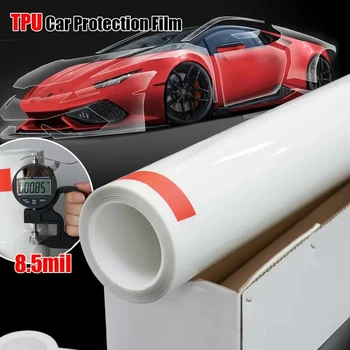
Paint protection film is a buying decision most people overthink until they get their first stone chip on a new car. This 8.5 mil TPU film is a bulk-roll PPF designed for DIY partial coverage or professional full-body installation. The spec sheet is straightforward. What matters is understanding what 8.5 mil actually buys you compared to thinner alternatives, and whether this film’s self-healing behaviour meets your expectations.
Thickness: why 8.5 mil matters
Most entry-level PPF rolls are sold at 4 to 6 mil. At 8.5 mil (approximately 215 microns), this film sits in the mid-to-upper tier for impact absorption. The added thickness directly improves resistance to stone chips, road grit abrasion, and car wash brush contact. It also improves conformability around compound curves – thicker TPU holds its shape better on bumper edges and mirror caps than thinner films that tend to lift at stress points.
Self-healing behaviour
The top coat on this film is a thermally activated elastomer. Light surface scratches, swirl marks from wiping, and fingernail contact close within approximately one second when heat is applied – sunlight, a heat gun on low, or hot water all trigger the response. This does not repair deep cuts that penetrate through the film to the adhesive layer, and it does not heal impact craters. The self-healing property is most useful for maintaining gloss clarity over the life of the film, not for recovering from significant impact damage.
Optical clarity and finish
The film is optically clear with a high-gloss finish that does not alter the appearance of metallic, pearlescent, or solid paint colours. There is no orange peel texture on this film. The non-yellowing formula uses UV stabilisers in both the TPU layer and the adhesive to prevent the amber discolouration that affects cheaper PVC-based films over time. The rated warranty period is 6 years.
Hydrophobic properties
The top coat has moderate hydrophobic properties. Water beads and sheets off the surface, which reduces water spotting and makes routine washing easier. It does not perform at the level of a dedicated ceramic coating, but combined with the physical protection layer, it reduces the frequency of detail work needed to maintain paint condition.
Available sizes
| Size | Dimensions | Best use |
|---|---|---|
| Small roll | 50 cm x 1.52 m | Door edges, mirror caps, door handles |
| Medium roll | 50 cm x 3 m | Hood leading edge, bumper strips |
| Full width roll | 152 cm x 1.52 m | Full hood or full bumper sections |
| Large full width roll | 152 cm x 3 m | Full panel coverage, professional installs |
Installation overview
The film uses a pressure-sensitive adhesive with a slip layer that allows repositioning during installation. The standard wet install method applies here: clean the surface thoroughly to remove wax, polish residue, and contaminants, then prepare a slip solution of water with a small amount of car shampoo (not shower gel — car shampoo is pH neutral and leaves no residue). Peel the film backing, wet the adhesive side, position the film, and squeegee from the center outward to remove water and air. Use a heat gun on low heat to stretch the film around curved edges and set the adhesive at corners.
For door edge strips and flat panels, competent DIY installation is achievable with patience. For full hood, full bumper, or full body coverage, professional installation is strongly recommended. Improper stretching creates stress lines that become visible over time, and adhesive contamination from finger oils during handling causes lifting at edges.
Specifications
| Detail | Value |
|---|---|
| Material | TPU (Thermoplastic Polyurethane) |
| Thickness | 8.5 mil / 215 microns |
| Finish | High gloss transparent |
| Self-healing | Yes, thermally activated |
| UV resistance | Yes |
| Hydrophobic | Yes |
| Warranty | 6 years |
| Compatibility | Universal, all vehicle paint types |
| Surfaces not suitable | Damaged, peeling, or unprimed paint |
Frequently Asked Questions
Can I apply this over existing ceramic coating? Yes. PPF bonds to the paint surface and can be applied over cured ceramic coating. The ceramic coating will remain under the film and continue to protect the paint if the PPF is later removed. The film adhesive does not bond as strongly to ceramic-coated surfaces as it does to bare clear coat, so edge sealing is more important on ceramic-coated panels.
Will it leave adhesive residue when removed? When removed within the warranty period and at normal temperatures, this film should not leave adhesive residue on factory clear coat in good condition. Heat the film gently before peeling to soften the adhesive and pull slowly at a low angle. Aged or sun-damaged clear coat is more susceptible to adhesive transfer on any PPF product.
Can this be applied over matte or satin paint? No. This is a high-gloss film. Applying it over matte or satin finishes will alter the sheen of the covered area. A separate matte PPF product is required for those finishes.
How does 8.5 mil compare to professional installer-grade PPF? Professional PPF brands typically run between 8 and 10 mil. At 8.5 mil, this film is within that range. The primary differences between this product and premium installer brands are the clarity of the adhesive at install (professional films have more forgiving working time), the precision of the self-healing top coat formulation, and the depth of the warranty support. For DIY partial coverage on a daily driver, this film performs well. For a full-body wrap on a high-value vehicle, professional-grade film with professional installation is a more reliable outcome.
What is the best size to buy for front bumper coverage? The 152 cm x 1.52 m roll provides enough material for most passenger car front bumpers with a single unjoined piece. The 50 cm x 3 m roll works for narrower sections or allows two attempts on smaller bumpers.